From Plaque to Tartar: How dental calculus forms and why it matters for your gums
Have you ever noticed a hard, yellowish deposit around your teeth that doesn't disappear no matter how well you brush?
You may be looking at dental calculus, commonly known as “tartar”.
Dental calculus develops when dental plaque—the soft bacterial biofilm that naturally forms on tooth surfaces—becomes mineralized. Unlike soft plaque, calculus cannot be effectively removed with a toothbrush or dental floss once it has hardened.
But how exactly does plaque turn into calculus? And why can these deposits contribute to gum inflammation and periodontal disease?
Understanding this process can help explain why daily oral hygiene and professional dental care are both important for maintaining healthy gums.
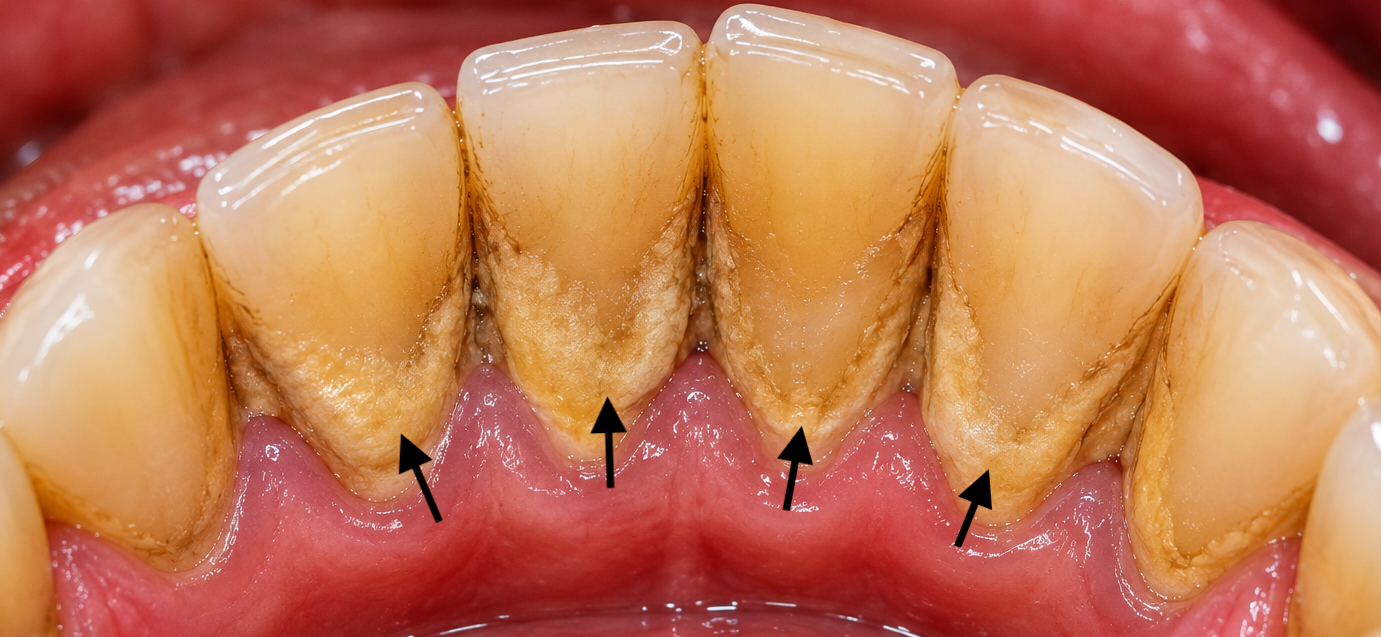
Dental calculus (arrows)
What is dental calculus?
Dental calculus (i.e. tartar) is the mineralized dental plaque. That is dental bacteria with mineral deposits, strongly fixed onto the teeth surfaces in the presence.
How does plaque become calculus?
The soft dental plaque found on teeth surfaces is hardened gradually by the precipitation of mineral salts originating mainly from the saliva. Initial calcification may occur within as little as 4 to 8 hours. It progressively hardens and adheres to tooth surfaces. It is worth mentioning that not all individuals present calculus with the same ease. Some form tartar slowly (“slow calculus formers”) whereas other may form it too quickly (“rapid calculus formers”).
Where does calculus usually form?
Calculus can potentially form on every tooth surface. It is usually located at sites where salivary gland ducts terminate, such as the lingual surfaces of the mandibular anterior and posterior teeth and buccal surfaces of maxillary molars. Nevertheless, calculus can occur on dental prostheses, such as dental crowns, implants, removable appliances and orthodontic devices.
Why does calculus matter?
Although tartar is inert by its nature, its physical characteristics contribute to the retention of dental plaque which can cause dental and periodontal issues. Dental plaque bacteria can adhere to its rough surface and provoke gingival inflammation. Tartar’s surface characteristics also help strongly adhere to tooth surfaces, making its removal challenging.
Can you remove dental calculus by brushing?
Although dental plaque which is soft in nature can be removed from tooth surfaces with regular tooth brushing and interdental cleaning, tartar is harder to remove. As aforementioned, the latter may strongly adhere to tooth surfaces. Therefore, professional instrumentation with ultrasonic devices (usually called “professional tooth cleaning”) is needed to destruct the hard structure of calculus.
How can calculus formation be reduced?
Daily brushing with fluoride toothpaste and interdental cleaning can help reduce the bacterial load retained on tooth surfaces, thereby lowering down calculus levels. Certain mouthwashes and chewing gums have been reported to possess an anti-tartar effect by impeding the calcification of the dental plaque, but they are not recommended for everyday use, as they have secondary effects too, like developing bacterial resistance, stain retention and constipation. Professional care with ultrasonic devices is key to calculus removal, as mechanical instrumentation is the only means that can effectively detach calculus from tooth surfaces.
When should you see your dentist?
Seeking professional care is necessary to avoid/reduce the formation of calculus, as individual instructions and proper treatment may be provided based on the personalized disease occurrence risk of the patient. Usually, a regular visit to the dentist or the dental hygienist every 6 months is advisable.